Showing posts with label Cone 10. Show all posts

Wednesday, June 11, 2014

Shino Glazes

     Shinos are one of my favorite types of glazes, if not my most favorite. They are incredibly variable and incredibly cheap. There's no need for expensive colorants - let alone any colorants for that matter - to make interesting colors in the glaze. That's not to say that colorant's can't be added, but there really isn't any need. With just various mixes of the basic ingredients that make up a shino (clay and feldspar at the most simplistic level) colors like tan, orange, red, gray, black, and gold can be achieved. And, they don't run so there isn't any worry for your shelves.
     There are a few types of shinos: Traditional, Carbon Trapping, Red, and High Alumina (or white, very similar to traditional but with more alumina). I don't have a personal High Alumina glaze, but these are my Traditional, Red, and Carbon Trap shinos:

Carbon Trap Shino

Neph Sye - 45
Spodumene - 15
OM4 - 15
F-4 Feldspar - 10
Redart - 5
Soda Ash - 18
Traditional Shino

Neph Sye - 70
Fire Clay - 30
Red Shino

Neph Sye - 20
EPK - 20
OM4 - 20
Soda Ash - 20
Spodumene -20

      A common shino idea is that you can mix 70% - 80% of Neph Sye with 20% - 30% of pretty much any clay to get a shino, and that's all my traditional shino is. There's no need to hunt down any Fire Clay to make one, just use OM4 or EPK. Really, any clay could work. Even XX Saggar - as seen below.
     I personally am a fan of Carbon Trap Shinos the most, so I experimented more on mine. Additions of various ingredients and substitutions of others have interesting effects.

Carbon Trap + 1% Rutile
Carbon Trap + 3% Rutile
Carbon Trap + 2% Rutile

Carbon Trap with 5 grams
extra Redard added
Carbon Trap with XX Saggar
substituted for OM4
Carbon Trap with Salt
substituted for Soda Ash

     Sodium is what captures the carbon in Carbon Trap shino's giving that nice gray - black speckling. Therefore, just about any high sodium material can be added in an attempt to trap carbon. Using wax resist right after glaze application will prevent sodium build up and show a wonderful effect of different colors in the glaze due to carbon trapping and fluxing. Substitutions like salt work well.
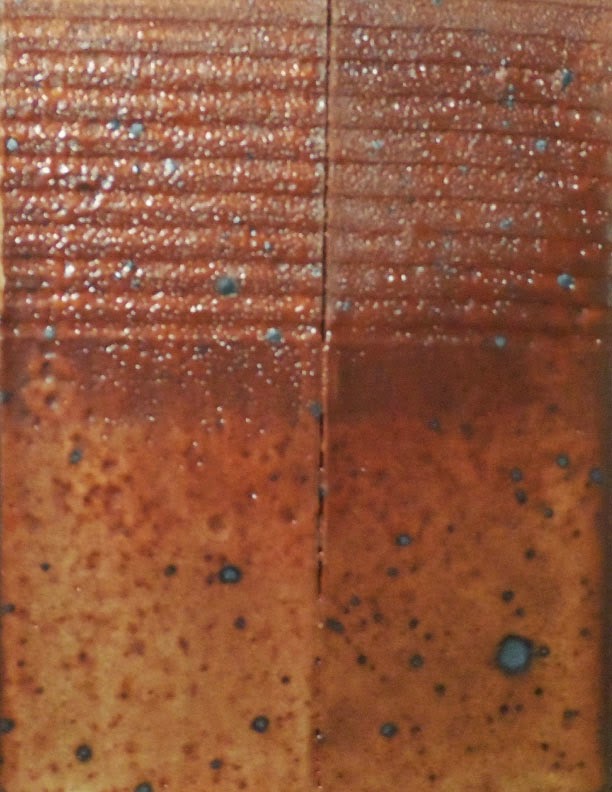
     Now, my Carbon Trap Shino already has a nice metalic lustrous shine, but with additions of Rutile increase that golden shine. Interestingly enough though, from 1, 2, and 3 percent the color changes from brown/gray to blue/black, to gold respectively.

     However, there are some important things to know about shinos:

  • Because they have such high clay content they generally have a higher melting point that other glazes. This means that other glazes should generally be layered on top of them if you layer glazes. That's not to say that some artists have success disregarding this, because some do.  
  • Iron Oxide washes painted on top of a shino will go gun metal and run.
  • The crazed surface in high sodium shinos will bed bacteria just like other crazed surfaces.
  • Shinos are fired in reduction, and the Carbon Trapping shinos like heavy reduction firing.


Wednesday, January 22, 2014

Cone 10 Glaze Test Tiles

        These tiles are from a previous cone 10 reduction gas firing at Red Star Studios in Kansas City, MO. Unfortunately, I cannot explain the firing schedule for the firings there because I don't know them, but they are just normal firings; no soaking, no slow cooling, just basically fired to temp then turned off. All of the tiles are made of White Stoneware and were placed in the middle of the kiln, together.


MC Spodumene

Custer Feldspar - 30
EPK - 28
Whiting - 5
Dolomite - 25
Spodumene - 10
Tin Oxide - 2
 Permafrost  +10% Rutile

Neph Sye - 45
Flint - 30
Whiting - 8
Dolomite - 10
Talc - 7
--------------------
Rutile - 10%
Permafrost +2% Cobalt Carb

Neph Sye - 45
Flint - 30
Whiting - 8
Dolomite - 10
Talc - 7
--------------------
Cobalt Carb - 2%
      
        The Permafrost base is a opaque satin white without colorants. It runs slightly, and more so with added oxides. Exceeding 3.5% Red Iron Oxide is not a good idea because it fluxes the glaze enough to run of the clay like a crystaline glaze. Separated yellow iron crystals form at 4% on a dark brown background. Copper Carbonate does not flux the glaze to a largely noticeable amount and turns the base pink at 1% with increasing flowering of green as you reach 5% until completely green. However, the copper doesn't melt the glaze past a satin in the 1% - 5% tests I did. 


MC Fake Nuka Base

Flint - 30
Custer Feldspar - 37
Bone Ash - 2
Whiting - 23
OM4 - 6
Talc - 2
Base 2A

Cornwall Stone - 46
Whiting - 34
Flint - 20
Base 1

Soda Feldspar - 65
Flint - 20
Whiting - 5
EPK - 5
Dolomite - 5


These white bases are all on the glossier side. The Fake Nuka shows signs of blue iron crystals forming from iron leaching from the clay body - small amounts of Red Iron Oxide (possibly .5%) would make a nice iron blue glaze. Base 2A crackles after firing (as apposed to during ) and thickness increases the strength of the crackle. The black ink on Base 2A is black Sharpie wiped directly after marking on with a wet paper towel.


MC Tomato Red

Flint - 15
Custer Feldspar - 30
EPK - 25
Whiting - 15
Bone Ash - 5
--------------------
Red Iron Oxide - 7
Tin Oxide - 1
MC Copper Red

Neph Sye - 45
Flint - 30
Whiting - 8
Spodumene - 17
--------------------
Copper Carb - 2
Rutile - 1
MC Red Tenmoku
Custer Feldspar - 77
Whiting - 6
Flint - 1
EPK - 4
Gerstly Borate - 13

 --------------------
Red Iron Oxide - 9

        My copper red glaze does not run very noticeably, unlike most oxblood variations. The Tenmoku does run, however, as you can see by the black pool. The running of what would normally be the dark body of a tenmoku glaze allows for the red to show. 


Shorn Base +2% Copper Carb

Wollastonite - 25
Spodumene - 25
Cornwall Stone - 25
Talc - 25
--------------------
Copper Carb - 4%
    
     Shorn Base + 2% Cobalt Carb
      and 1% Copper Carb

     Wollastonite - 25
      Spodumene - 25
      Cornwall Stone - 25
      Talc - 25
      --------------------
     Cobalt Carb - 2%
     Copper Carb - 1%
Seafoam

Custer Feldspar - 40
Whiting - 30
Flint - 15
EPK - 10
Spodumene - 5 

--------------------
Yellow Ochre - 2


        The Shorn base is very runny, just like other crystaline glazes, so be careful with both application and kiln shelf protection. Without colorants it is white on white. Copper Carb gradually changes the glaze from pale teal with lighter teal crystals (at 1%) to a more vivid teal with gunmetal crystals (at 5%). Cobalt produces a dark blue with purple crystals, Iron produces brown and yellow, Chrome produces green and green. Mixing of colorants should produce interesting color combinations between the crystals and the glaze matrix. Increased amount of colorants increases running.


Satin Base +2% Copper Carb
and 3% Rutile

Custer Feldspar - 45
EPK - 25
Whiting - 15
Neph Sye - 15

--------------------
Copper Carb - 2%
Rutile - 3%
         
            Satin Base
         +2% Chrome oxide
         and 3% Rutile

          Custer Feldspar - 45
         EPK - 25
       Whiting - 15
       Neph Sye - 15

       --------------------
       Chrome Oxide - 2%
       Rutile - 3%


Speckle Base
 +1% Cobalt Carb
and 1% Nickle Dioxide

Wollastonite - 6
Custer Feldspar - 28
EPK - 28
Flint - 15
Dolomite - 19
Gerstly Borate - 4
--------------------
Tin Oxide - 1%
Cobalt Carb - 1%
Nickle Dioxide - 1%


        The Satin Base is a simple base the produces simple colors. Additions of Rutile or Titanium Dioxide increase the complexity of the coloring. This base also responds vividly to thickness changes, and doesn't run whatsoever. Less dull colors are easily obtainable by removing the rutile. The Speckled Base runs slightly and darkens where pooled. Change the colorants, but always keep the Tin Oxide as that is what produces the speckling.


Glossy Frog Skin 1

Flint - 25
Dolomite - 8
Custer Feld - 55
EPK - 7
Borax - 5
--------------------
Copper Carb - 4%
Cobalt Carb - 0.5%
Red Iron Oxide - 2%
Titanium Dioxide - 2
           
           Glossy Frog Skin 2

           Flint - 25
          Dolomite - 8
          Custer Feld - 55
          EPK - 7
             Borax - 5    
       --------------------
        Copper Carb - 2%
         Red Iron Oxide - 0.5%
       Titanium Dioxide - 3%


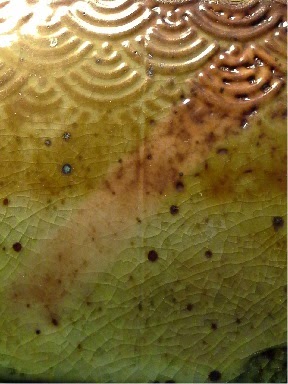
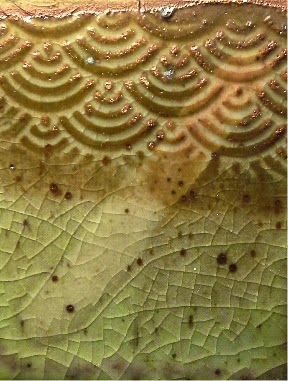
The Glossy Frog Skin Base is a nice glossy base on its own, but it responds well to excessive amounts of colorants - both by quantity of colorants and quantity of percentage of each colorant. Increased colorants enlarged the dotting of colors but also makes it run more. Without excessive colorants, the glaze doesn't noticeably run.