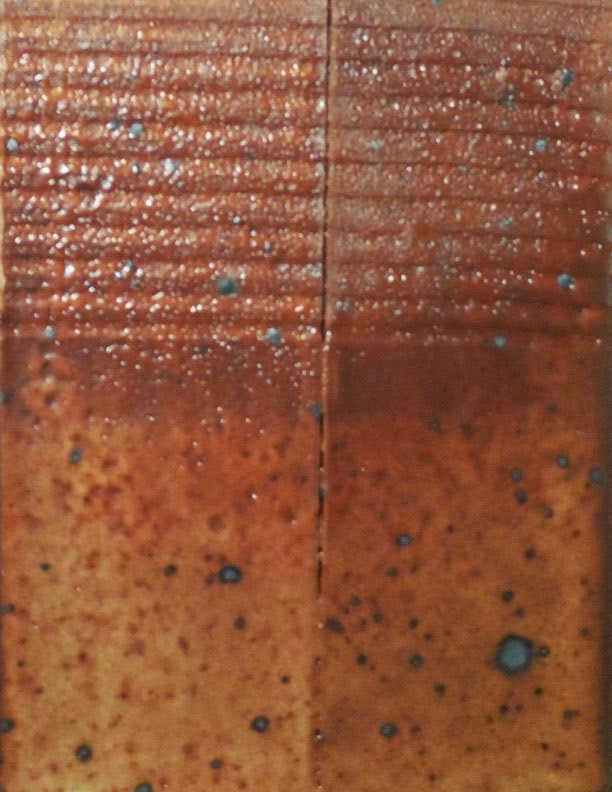
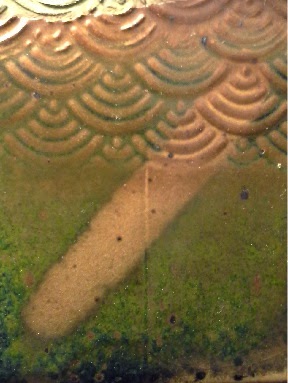
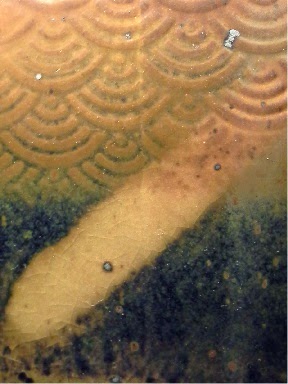
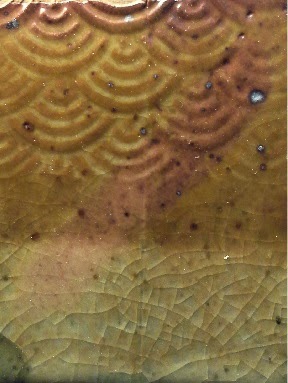
In glaze testing, sometimes finding a color or glaze surface you like can be a challenge. Line Blending, with all its variables, can assist in making it less so. Line Blending is basically a way to gradually change variables in a glaze recipe. The most simple line blend is a Single Variable Line Blend:

In a Single Variable Line Blend you increase the percentage of something in addition to the 100% recipe. This makes Single Variable Line Blends incredibly helpful in finding the right amount of colorant or opacifier you'd like in a glaze. The numbers at the top of each figure is the number of each tile. For this type of line blend, A represents a base glaze and B represents an additive. Taking a clear glaze and adding percentages of Red Iron Oxide, for example, could take you from a celadon to an amber to a Tenmoku (However I'd increase the percentages by .5% instead of 1%). The percentages show above are just listen to illustrate the idea, but you can change the increments between each tile by any amount.
The easiest way I've found to do this type of line blend, rather than mix up seven separate glaze slops, is to mix a 500 gram batch of the base and dip tile 1, then add 1% of the additive and dip tile 2, add another 1% of the additive and dip tile 3, and so on until finished. Obviously, this is not exact because you take away some of the base with each dip, but its close enough to get you in the right area for the color you're looking for.

The next form of Line blend is a Double Variable Line Blend. This line blend is good for mixing two additives (Copper Carbonate and Tin Oxide for example) to find the right mix of both. This type of line blend, as well as all of the following line blends are completed using a much different process than a Single Variable Line Blend. For this, and all of the following blends, you mix up a glaze slop of the base for each letter. Then in each glaze slop you add whatever you'd like to be blending. The more tiles you will be dipping the larger of a glaze batch you'll need to make.
For example, you could have two 500 gram batches of:
Custer Feldspar - 34
EPK - 33
Whiting - 33
In one batch you add 5% Red Iron Oxide (which would be 25 grams) and in the other you add 10% Titanium Dioxide (which would be 50 grams). Then you use a spoon to take the proportion of each batch into the mix - Tile 5 for example would be two spoonfuls of batch A and four spoonfuls of batch B. This is demonstrated in the image below. Thoroughly stir the mix and dip your tile.

To calculate the recipe of a single tile, follow the image below.

The following types of line blending are all complete the same way as Double Variable Line blends, however they require increased amounts of glaze slops (Biaxial and Triaxial require three, and hexaxial requires six).


The Hexaxial Line Blend is a beast of my making. If you're looking for a specific glaze base you can put one material on each corner and blend them to find 37 different bases. Most of them might not work, but this allows you to see lots of different bases all at once. It also works just like any other line blend and you can have one base with 6 different additives.
The reason the tiles skip numbers unlike the previous line blends is that it would require an enormous amount of tiles to make it have smaller increments, but line blending is a general experiment anyway. As you do line blends and become more particular with what you're looking for you can hone in on the area of a line blend you like the most.
If you have questions please feel free to ask, and if you have tested any of these (especially the Hexaxial) and would like to share please do!