 |
| The many faces of Copper Carbonate |
Copper Carb can create red (in reduction) in glazes that have low clay content - less than 10% - high alkaline flux content, contain Tin Oxide in amounts of 1% - 5%, and Copper Carb in amount of 1% - 5%. Heavy reduction aids in their production, however over firing them can burn out the copper leaving them white or tan.
 |
| Copper Red Attempt 1 |
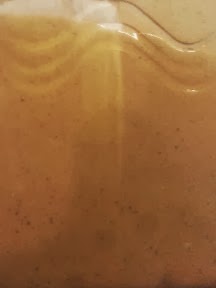
Copper Red Attempt 1:
Flint - 25
Dolomite - 8
Custer Feld - 55
EPK - 7
Borax - 5
-----------------
Tin Oxide - 2%
Copper Carb - 0.5%
Red Iron Oxide - 0.5%
As all of these tiles were fired under the same schedule and other copper reds were produced under the same schedule, firing was not a probable issue.
I added Red Iron Oxide to try to help in production of red, but the copper was in too low of a percentage. The 7% EPK also most likely had a negative effect on whether red could have been produced. This base, although unsuitable for copper red, became a nice glossy base called Glossy Frog Skin.
 |
| Copper Red Attempt 2 |
Flint - 25
Dolomite - 8
Custer Feld - 55
EPK - 7
Borax - 5
-----------------
Titanium Dioxide - 3%
Copper Carb - 2%
Red Iron Oxide - 0.5%
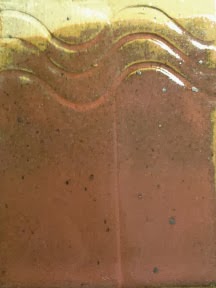
In this attempt I correctly changed the Tin Oxide to Titanium Dioxde, to see if Titanium would have a positive effect rather than Tin (it did not), however both the Titanium Dioxide and Red Iron Oxide were in too high of percentages. Besides additives, this base did not seem capable of producing a Copper Red, not easily anyway. Rather than producing red, this base was producing yellows, tans, and browns.
 |
| Copper Red |
Copper Red Attempt 3:
Neph Sye - 45
Flint - 30
Whiting - 8
Spodumene - 17
------------------
Copper Carb - 2%
Rutile - 1%
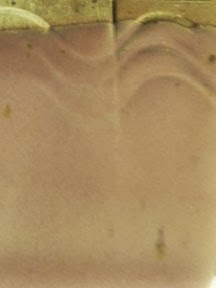
For this attempt I changed the base to one that (1) does not include EPK, (2) uses Lithium and Sodium as fluxes instead of Potassium and Boron, and (3) uses whiting to add opacity instead of Dolomite. I also substituted both Red Iron Oxide and Titanium Dioxide or Tin Oxide for Rutile - a material that contains both TiO2 and Fe3O2.
This recipe succeeded to create a Copper Red glaze that does not run very much and breaks translucent yellow/tan instead of opaque white. It is also an example that good looking glazes are not exclusively made of complex recipes. Sometimes the simplest answer is the best.
 |
| Copper Pink - Permafrost |
Copper Pink:
Neph Sye - 45
Flint - 30
Whiting - 8
Dolomite - 10
Talc - 7
-----------------
Copper Carb - 1%
Copper Red glazes can be varied to create a pink, just be using an opacifier to lighten the glaze. This can be seen in the Permafrost Base with 1% Copper Carb. The permafrost also shows that it is possibly to take a copper red and have it bloom green with more Copper Carb. The only large difference between my Copper Red and this glaze recipe is that Spodumene was substituted to Dolomite and Talc and there is no Titanium Dioxide or Tin Oxide added.


